 3fdf586e0d
internal variables

feat: enables exchange

data: added exchange only benchmark

data: applied required changes to benchmarks
POET
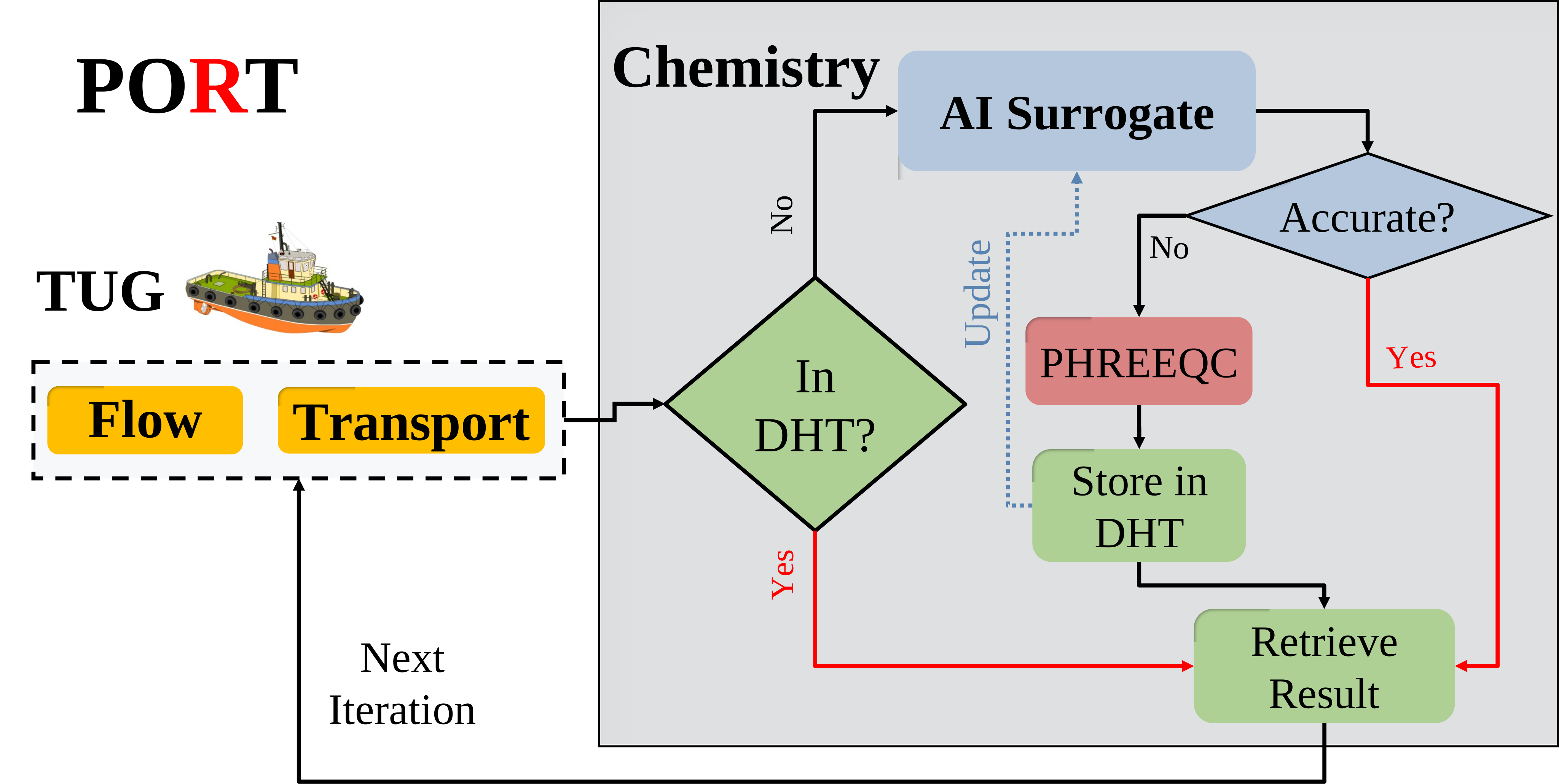
POET is a coupled reactive transport simulator implementing a parallel architecture and a fast, original MPI-based Distributed Hash Table.
Parsed code documentiation
A parsed version of POET's documentiation can be found at Gitlab pages.
External Libraries
The following external header library is shipped with POET:
- argh - https://github.com/adishavit/argh (BSD license)
- PhreeqcRM with patches from GFZ - https://www.usgs.gov/software/phreeqc-version-3 - https://git.gfz-potsdam.de/mluebke/phreeqcrm-gfz
- tug - https://git.gfz-potsdam.de/sec34/tug
Installation
Requirements
To compile POET you need several software to be installed:
- C/C++ compiler (tested with GCC)
- MPI-Implementation (tested with OpenMPI and MVAPICH)
- R language and environment
- CMake 3.9+
- optional:
doxygenwithdotbindings for documentiation
The following R libraries must then be installed, which will get the needed dependencies automatically:
Compiling source code
The generation of makefiles is done with CMake. You should be able to generate Makefiles by running:
mkdir build && cd build
cmake ..
This will create the directory build and processes the CMake files
and generate Makefiles from it. You're now able to run make to start
build process.
If everything went well you'll find the executable at
build/app/poet, but it is recommended to install the POET project
structure to a desired CMAKE_INSTALL_PREFIX with make install.
During the generation of Makefiles, various options can be specified
via cmake -D <option>=<value> [...]. Currently, there are the
following available options:
- POET_DHT_Debug=boolean - toggles the output of detailed statistics about DHT usage. Defaults to OFF.
- POET_ENABLE_TESTING=boolean - enables small set of unit tests (more to come). Defaults to OFF.
- POET_USE_PRM_BACKEND=bollean - use the PhreeqcRM parallelization instead of POET's one. Intended for debugging purposes for modellers.
Example: Build from scratch
Assuming that only the C/C++ compiler, MPI libraries, R runtime environment and CMake have been installed, POET can be installed as follows:
# start R environment
$ R

# install R dependencies
> install.packages(c("Rcpp", "RInside"))
> q(save="no")

# cd into POET project root
$ cd <POET_dir>

# Build process
$ mkdir build && cd build
$ cmake -DCMAKE_INSTALL_PREFIX=/home/<user>/poet ..
$ make -j<max_numprocs>
$ make install
This will install a POET project structure into /home/<user>/poet
which is called hereinafter <POET_INSTALL_DIR>. With this version of
POET we do not recommend to install to hierarchies like
/usr/local/ etc.
The correspondending directory tree would look like this:
poet
├── bin
│   └── poet
├── R_lib
│   └── kin_r_library.R
└── share
    └── poet
        ├── bench
        │   ├── dolo_diffu_inner_large.R
        │   ├── dolo_diffu_inner.R
        │   └── dolo_inner.pqi
        └── examples
            ├── dol.pqi
            ├── phreeqc_kin.dat
            ├── SimDol1D_diffu.R
            └── SimDol2D_diffu.R
The R libraries will be loaded at runtime and the paths are hardcoded
absolute paths inside poet.cpp. So, if you consider to move
bin/poet either change paths of the R source files and recompile
POET or also move R_lib/* relative to the binary.
Running
Run POET by mpirun ./poet <OPTIONS> <SIMFILE> <OUTPUT_DIRECTORY>
where:
- OPTIONS - runtime parameters (explained below)
- SIMFILE - simulation described as R script (e.g.
<POET_INSTALL_DIR>/share/examples/SimDol2D_diffu.R) - OUTPUT_DIRECTORY - path, where all output of POET should be stored
Runtime options
The following parameters can be set:
| Option | Value | Description |
|---|---|---|
| --work-package-size= | 1..n | size of work packages (defaults to 5) |
| --ignore-result | disables store of simulation resuls | |
| --dht | enabling DHT usage (defaults to OFF) | |
| --dht-signif= | 1..n | set rounding to number of significant digits (defaults to 5) (it is recommended to use signif_vec in R input script) |
| --dht-strategy= | 0-1 | change DHT strategy. NOT IMPLEMENTED YET (Defaults to 0) |
| --dht-size= | 1-n | size of DHT per process involved in megabyte (defaults to 1000 MByte) |
| --dht-snaps= | 0-2 | disable or enable storage of DHT snapshots |
| --dht-file= | <SNAPSHOT> |
initializes DHT with the given snapshot file |
Additions to dht-signif
Only used if no vector is given in setup file. For individual values
per column use R vector signif_vector in SIMFILE.
Additions to dht-snaps
Following values can be set:
- 0 = snapshots are disabled
- 1 = only stores snapshot at the end of the simulation with name
<OUTPUT_DIRECTORY>.dht - 2 = stores snapshot at the end and after each iteration iteration
snapshot files are stored in
<DIRECTORY>/iter<n>.dht
Example: Running from scratch
We will continue the above example and start a simulation with
SimDol2D_diffu.R. As transport a simple fixed-coefficient diffusion is used.
It's a 2D, 100x100 grid, simulating 10 time steps. To start the simulation with
4 processes cd into your previously installed POET-dir
<POET_INSTALL_DIR>/bin and run:
mpirun -n 4 ./poet ../share/poet/examples/SimDol2D_diffu.R output
After a finished simulation all data generated by POET will be found
in the directory output.
You might want to use the DHT to cache previously simulated data and reuse them
in further time-steps. Just append --dht to the options of POET to activate
the usage of the DHT. Also, after each iteration a DHT snapshot shall be
produced. This is done by appending the --dht-snaps=<value> option. The
resulting call would look like this:
mpirun -n 4 ./poet --dht --dht-snaps=2 ../share/poet/examples/SimDol2D_diffu.R output
About the usage of MPI_Wtime()
Implemented time measurement functions uses MPI_Wtime(). Some
important information from the OpenMPI Man Page:
For example, on platforms that support it, the clock_gettime() function will be used to obtain a monotonic clock value with whatever precision is supported on that platform (e.g., nanoseconds).