
14 KiB
POET
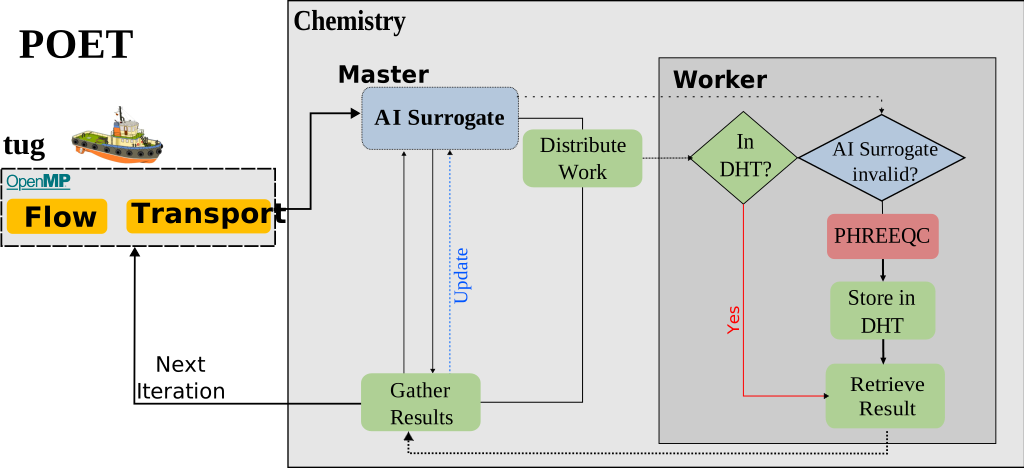
POET is a coupled reactive transport simulator implementing a parallel architecture and a fast, original MPI-based Distributed Hash Table.
Parsed code documentiation
A parsed version of POET's documentation can be found at Gitlab pages.
External Libraries
The following external libraries are shipped with POET:
- CLI11 - https://github.com/CLIUtils/CLI11
- IPhreeqc with patches from GFZ/UP - https://github.com/usgs-coupled/iphreeqc - https://git.gfz-potsdam.de/naaice/iphreeqc
- tug - https://git.gfz-potsdam.de/naaice/tug
Installation
Requirements
To compile POET you need following software to be installed:
- C/C++ compiler (tested with GCC)
- MPI-Implementation (tested with OpenMPI and MVAPICH)
- CMake 3.9+
- Eigen3 3.4+ (required by
tug) - optional:
doxygenwithdotbindings for documentation - R language and environment including headers or
-devpackages (distro dependent)
The following R packages (and their dependencies) must also be installed:
This can be simply achieved by issuing the following commands:
# start R environment
$ R

# install R dependencies (case sensitive!)
> install.packages(c("Rcpp", "RInside","qs"))
> q(save="no")
Clone the repository
POET can be anonimously cloned from this repo over https. Make sure to also download the submodules:
git clone --recurse-submodules https://git.gfz-potsdam.de/naaice/poet.git
The --recurse-submodules option is a shorthand for:
cd poet
git submodule init && git submodule update
Compiling source code
POET is built with CMake. You can generate Makefiles by running the usual:
mkdir build && cd build
cmake ..
This will create the directory build and processes the CMake files
and generate Makefiles from it. You're now able to run make to start
build process.
If everything went well you'll find the executables at
build/src/poet, but it is recommended to install the POET project
structure to a desired CMAKE_INSTALL_PREFIX with make install.
During the generation of Makefiles, various options can be specified
via cmake -D <option>=<value> [...]. Currently, there are the
following available options:
- POET_DHT_Debug=boolean - toggles the output of detailed statistics about DHT usage. Defaults to OFF.
- POET_ENABLE_TESTING=boolean - enables small set of unit tests (more to come). Defaults to OFF.
- POET_PHT_ADDITIONAL_INFO=boolean - enabling the count of accesses to one PHT bucket. Use with caution, as things will get slowed down significantly. Defaults to OFF.
- POET_PREPROCESS_BENCHS=boolean - enables the preprocessing of predefined models/benchmarks. Defaults to ON.
- USE_AI_SURROGATE=boolean - includes the functions of the AI
surrogate model. When active, CMake relies on
find_package()to find an a implementation ofThreadsand a Python environment where Numpy and Keras need to be installed. Defaults to OFF.
Example: Build from scratch
Assuming that only the C/C++ compiler, MPI libraries, R runtime environment and CMake have been installed, POET can be installed as follows:
# start R environment
$ R

# install R dependencies
> install.packages(c("Rcpp", "RInside","qs"))
> q(save="no")

# cd into POET project root
$ cd <POET_dir>

# Build process
$ mkdir build && cd build
$ cmake -DCMAKE_INSTALL_PREFIX=/home/<user>/poet ..
$ make -j<max_numprocs>
$ make install
This will install a POET project structure into /home/<user>/poet
which is called hereinafter <POET_INSTALL_DIR>. With this version of
POET we do not recommend to install to hierarchies like
/usr/local/ etc.
The correspondending directory tree would look like this:
poet
├── bin
│   ├── poet
│   └── poet_init
└── share
    └── poet
        ├── barite
        │   ├── barite_200.rds
        │   ├── barite_200_rt.R
        │   ├── barite_het.rds
        │   └── barite_het_rt.R
        ├── dolo
        │   ├── dolo_inner_large.rds
        │   ├── dolo_inner_large_rt.R
        │   ├── dolo_interp.rds
        │   └── dolo_interp_rt.R
        └── surfex
            ├── PoetEGU_surfex_500.rds
            └── PoetEGU_surfex_500_rt.R
With the installation of POET, two executables are provided:
poet- the main executable to run simulationspoet_init- a preprocessor to generate input files for POET from R scripts
Preprocessed benchmarks can be found in the share/poet directory
with an according runtime setup. More on those files and how to
create them later.
Running
Run POET by mpirun ./poet [OPTIONS] <RUNFILE> <SIMFILE> <OUTPUT_DIRECTORY> where:
- OPTIONS - POET options (explained below)
- RUNFILE - Runtime parameters described as R script
- SIMFILE - Simulation input prepared by
poet_init - OUTPUT_DIRECTORY - path, where all output of POET should be stored
POET command line arguments
The following parameters can be set:
| Option | Value | Description |
|---|---|---|
| --work-package-size= | 1..n | size of work packages (defaults to 5) |
| -P, --progress | show progress bar | |
| --ai-surrogate | activates the AI surrogate chemistry model (defaults to OFF) | |
| --dht | enabling DHT usage (defaults to OFF) | |
| --qs | store results using qs::qsave() (.qs extension) instead of default RDS (.rds) | |
| --dht-strategy= | 0-1 | change DHT strategy. NOT IMPLEMENTED YET (Defaults to 0) |
| --dht-size= | 1-n | size of DHT per process involved in megabyte (defaults to 1000 MByte) |
| --dht-snaps= | 0-2 | disable or enable storage of DHT snapshots |
| --dht-file= | <SNAPSHOT> |
initializes DHT with the given snapshot file |
| --interp-size | 1-n | size of PHT (interpolation) per process in megabyte |
| --interp-bucket-entries | 1-n | number of entries to store at maximum in one PHT bucket |
| --interp-min | 1-n | number of entries in PHT bucket needed to start interpolation |
Additions to dht-snaps
Following values can be set:
- 0 = snapshots are disabled
- 1 = only stores snapshot at the end of the simulation with name
<OUTPUT_DIRECTORY>.dht - 2 = stores snapshot at the end and after each iteration iteration
snapshot files are stored in
<DIRECTORY>/iter<n>.dht
Example: Running from scratch
We will continue the above example and start a simulation with
barite_het, which simulation files can be found in
<INSTALL_DIR>/share/poet/barite/barite_het*. As transport a
heterogeneous diffusion is used. It's a small 2D grid, 2x5 grid,
simulating 50 time steps with a time step size of 100 seconds. To
start the simulation with 4 processes cd into your previously
installed POET-dir <POET_INSTALL_DIR>/bin and run:
cp ../share/poet/barite/barite_het* .
mpirun -n 4 ./poet barite_het_rt.R barite_het.rds output
After a finished simulation all data generated by POET will be found
in the directory output.
You might want to use the DHT to cache previously simulated data and
reuse them in further time-steps. Just append --dht to the options
of POET to activate the usage of the DHT. Also, after each iteration a
DHT snapshot shall be produced. This is done by appending the
--dht-snaps=<value> option. The resulting call would look like this:
mpirun -n 4 ./poet --dht --dht-snaps=2 barite_het_rt.R barite_het.rds output
Example: Preparing Environment and Running with AI surrogate
To run the AI surrogate, you need to have a Keras installed in your
Python environment. The implementation in POET is agnostic to the exact
Keras version, but the provided model file must match your Keras version.
Using Keras 3 with .keras model files is recommended. The compilation
process of POET remains mostly the same as shown above, but the CMake
option -DUSE_AI_SURROGATE=ON must be set.
To use the AI surrogate, you must declare several values in the R input
script. This can be either done directly in the input script or in an
additional file. This file can be provided by adding the file path as the
element ai_surrogate_input_script to the chemistry_setup list in the
R input script.
The following variables and functions must be declared:
-
model_file_path[string]: Path to the Keras model file with which the AI surrogate model is initialized. -
validate_predictions(predictors, prediction)[function]: Must return a boolean vector of lengthnrow(predictions). The output of this function defines which predictions are considered valid and which are rejected. the predictors and predictions are passed in their original original (not transformed) scale. Regular simulation will only be done for the rejected values. The input data of the rejected rows and the respective true results from simulation will be added to the training data buffer of the AI surrogate model. Can eg. be implemented as a mass balance threshold between the predictors and the prediction.
The following variables and functions can be declared:
-
batch_size[int]: Batch size for the inference and training functions, defaults to 2560. -
training_epochs[int]: Number of training epochs with each training data set, defaults to 20. -
training_data_size[int]: Size of the training data buffer. After the buffer has been filled, the model starts training and removes this amount of data from the front of the buffer. Defaults to the size of the Field. -
use_Keras_predictions[bool]: Decides if the Keras prediction function should be used instead of the custom C++ implementation. Keras might be faster for larger models, especially on GPU. The C++ inference function assumes that the Keras model is a standrad feed forward network with either 32 or 64 bit precision and ReLU activation. Any model that deviates from this architecture should activate the Keras prediction function to ensure correct calculation. Defaults to false. -
disable_training[bool]: Deactivates the training functions. Defaults to false. -
train_only_invalid[bool]: Use only the data from PHREEQC for training instead of the whole field (which might contain the models own predictions). Defaults to false. -
save_model_path[string]: After each training step the current model is saved to this path as a .keras file. -
preprocess(df)[function]: Returns the scaled/transformed data frame. The default implementation uses no scaling or transformations. -
postprocess(df)[function]: Returns the rescaled/backtransformed data frame. The combination of preprocess() and postprocess() is expected to be idempotent. The default implementation uses no scaling or transformations. -
assign_clusters(df)[function]: Must return a vector of lengthnrow(predictions)that contains cluster labels as 0/1. According to these labels, two separate models will be used for inference and training. Cluster assignments can e.g. be done for the reactive and non reactive parts of the field. -
model_reactive_file_path[string]: Path to the Keras model file with which the AI surrogate model for the reactive cluster is initialized. If ommitted, the models for both clusters will be initialized frommodel_file_path
cd <installation_dir>/bin

# copy the benchmark files to the installation directory
cp <project_root_dir>/bench/barite/{barite_50ai*,db_barite.dat,barite.pqi} .

# preprocess the benchmark
./poet_init barite_50ai.R

# run POET with AI surrogate and GPU utilization
srun --gres=gpu -N 1 -n 12 ./poet --ai-surrogate barite_50ai_rt.R barite_50ai.rds output
Keep in mind that the AI surrogate is currently not stable or might also not produce any valid predictions.
Defining a model
In order to provide a model to POET, you need to setup a R script
which can then be used by poet_init to generate the simulation
input. Which parameters are required can be found in the
Wiki.
We try to keep the document up-to-date. However, if you encounter
missing information or need help, please get in touch with us via the
issue tracker or E-Mail.
poet_init can be used as follows:
./poet_init [-o, --output output_file] [-s, --setwd] <script.R>
where:
- output - name of the output file (defaults to the input file
name with the extension
.rds) - setwd - set the working directory to the directory of the input
file (e.g. to allow relative paths in the input script). However,
the output file will be stored in the directory from which
poet_initwas called.
About the usage of MPI_Wtime()
Implemented time measurement functions uses MPI_Wtime(). Some
important information from the OpenMPI Man Page:
For example, on platforms that support it, the clock_gettime() function will be used to obtain a monotonic clock value with whatever precision is supported on that platform (e.g., nanoseconds).