mirror of
https://git.gfz-potsdam.de/naaice/tug.git
synced 2025-12-13 09:28:23 +01:00

4.0 KiB
4.0 KiB
Validation Examples for 2D Heterogeneous Diffusion
Simple setup using deSolve/ReacTran
- Square of side 10
- Discretization: 11 × 11 cells
- All boundaries closed
- Initial state: 0 everywhere, 1 in the center (6,6)
- Time step: 1 s, 10 iterations
The matrix of spatially variable diffusion coefficients α is constant in 4 quadrants:
αx,y =
| 0.01 | 0.01 | 0.01 | 0.01 | 0.01 | 0.01 | 0.001 | 0.001 | 0.001 | 0.001 | 0.001 |
| 0.01 | 0.01 | 0.01 | 0.01 | 0.01 | 0.01 | 0.001 | 0.001 | 0.001 | 0.001 | 0.001 |
| 0.01 | 0.01 | 0.01 | 0.01 | 0.01 | 0.01 | 0.001 | 0.001 | 0.001 | 0.001 | 0.001 |
| 0.01 | 0.01 | 0.01 | 0.01 | 0.01 | 0.01 | 0.001 | 0.001 | 0.001 | 0.001 | 0.001 |
| 0.01 | 0.01 | 0.01 | 0.01 | 0.01 | 0.01 | 0.001 | 0.001 | 0.001 | 0.001 | 0.001 |
| 1 | 1 | 1 | 1 | 1 | 1 | 0.1 | 0.1 | 0.1 | 0.1 | 0.1 |
| 1 | 1 | 1 | 1 | 1 | 1 | 0.1 | 0.1 | 0.1 | 0.1 | 0.1 |
| 1 | 1 | 1 | 1 | 1 | 1 | 0.1 | 0.1 | 0.1 | 0.1 | 0.1 |
| 1 | 1 | 1 | 1 | 1 | 1 | 0.1 | 0.1 | 0.1 | 0.1 | 0.1 |
| 1 | 1 | 1 | 1 | 1 | 1 | 0.1 | 0.1 | 0.1 | 0.1 | 0.1 |
| 1 | 1 | 1 | 1 | 1 | 1 | 0.1 | 0.1 | 0.1 | 0.1 | 0.1 |
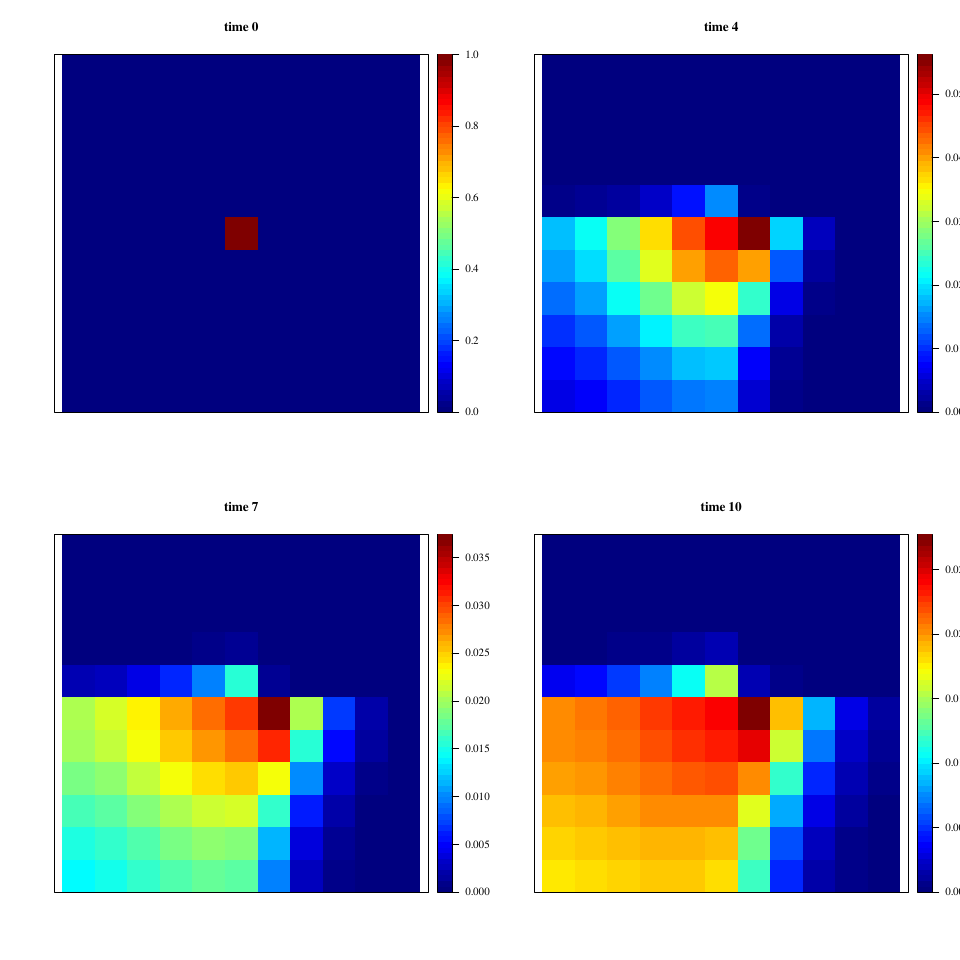
The relevant part of the R script used to produce these results is presented in listing 1; the whole script is at /max/tug/src/commit/8e5c1ad0356fc1cc1dfe3db19b40038f98e5be87/doc/scripts/HetDiff.R. A visualization of the output of the reference simulation is given in figure 1.
Note: all results from this script are stored in the outc matrix by
the deSolve function. I stored a different version into
/max/tug/src/commit/8e5c1ad0356fc1cc1dfe3db19b40038f98e5be87/scripts/gold/HetDiff1.csv: this file contains 11 columns (one
for each time step including initial conditions) and 121 rows, one for
each domain element, with no headers.
  library(ReacTran)
  library(deSolve)

  ## harmonic mean
  harm <- function(x,y) {
    if (length(x) != 1 || length(y) != 1)
    stop("x & y have different lengths")
    2/(1/x+1/y)
  }

  N     <- 11          # number of grid cells
  ini   <- 1           # initial value at x=0
  N2    <- ceiling(N/2)
  L     <- 10          # domain side

  ## Define diff.coeff per cell, in  4 quadrants
  alphas <- matrix(0, N, N)
  alphas[1:N2, 1:N2] <- 1
  alphas[1:N2, seq(N2+1,N)] <- 0.1
  alphas[seq(N2+1,N), 1:N2] <- 0.01
  alphas[seq(N2+1,N), seq(N2+1,N)] <- 0.001

  cmpharm <- function(x) {
    y <- c(0, x, 0)
    ret <- numeric(length(x)+1)
    for (i in seq(2, length(y))) {
      ret[i-1] <- harm(y[i], y[i-1])
    }
    ret
  }

  ## Construction of the 2D grid
  x.grid <- setup.grid.1D(x.up = 0, L = L, N = N)
  y.grid <- setup.grid.1D(x.up = 0, L = L, N = N)
  grid2D <- setup.grid.2D(x.grid, y.grid)
  dx <- dy <- L/N

  D.grid <- list()
  ## Diffusion coefs on x-interfaces
  D.grid$x.int <- apply(alphas, 1, cmpharm)
  ## Diffusion coefs on y-interfaces
  D.grid$y.int <- t(apply(alphas, 2, cmpharm))

  # The model
  Diff2Dc <- function(t, y, parms) {
    CONC  <- matrix(nrow = N, ncol = N, data = y)
    dCONC <- tran.2D(CONC, dx = dx, dy = dy, D.grid = D.grid)$dC
    return(list(dCONC))
  }

  ## initial condition: 0 everywhere, except in central point
  y <- matrix(nrow = N, ncol = N, data = 0)
  y[N2, N2] <- ini  # initial concentration in the central point...

  ## solve for 10 time units
  times <- 0:10
  outc <- ode.2D(y = y, func = Diff2Dc, t = times, parms = NULL,
		 dim = c(N, N), lrw = 1860000)